


PipeMan is an internationally field-proven pipeline management application suite engineered to support the safe, reliable, and cost-effective operation of liquid pipelines. Built to seamlessly align with SCADA engineering practices, PipeMan delivers real-time hydraulic monitoring, leak detection, batch tracking, custody transfer management, and advanced simulation modules—all through a unified, flexible software architecture
Key Platform Highlights
- Industry-Proven Reliability: Built on extensive real-world operational experience and field testing.
- High Adaptability: Easily extended with custom modules and integrated with all major SCADA environments.
- Scalable Architecture: Built on Java and HTML5 standards for platform independence across desktop, web, and mobile devices.
- Maximum Availability: Full duty/standby server redundancy with automatic failover to prevent operational downtime.
- Standard Integration: Native support for standard industrial interfaces, including OPC, native APIs, and SQL/ODBC databases.
System Architecture & SCADA Integration
PipeMan operates by taking real-time field telemetry—such as pressures, flow rates, temperatures, fluid densities, valve states, pump speeds, and tank levels—and running specialized online calculation engines.
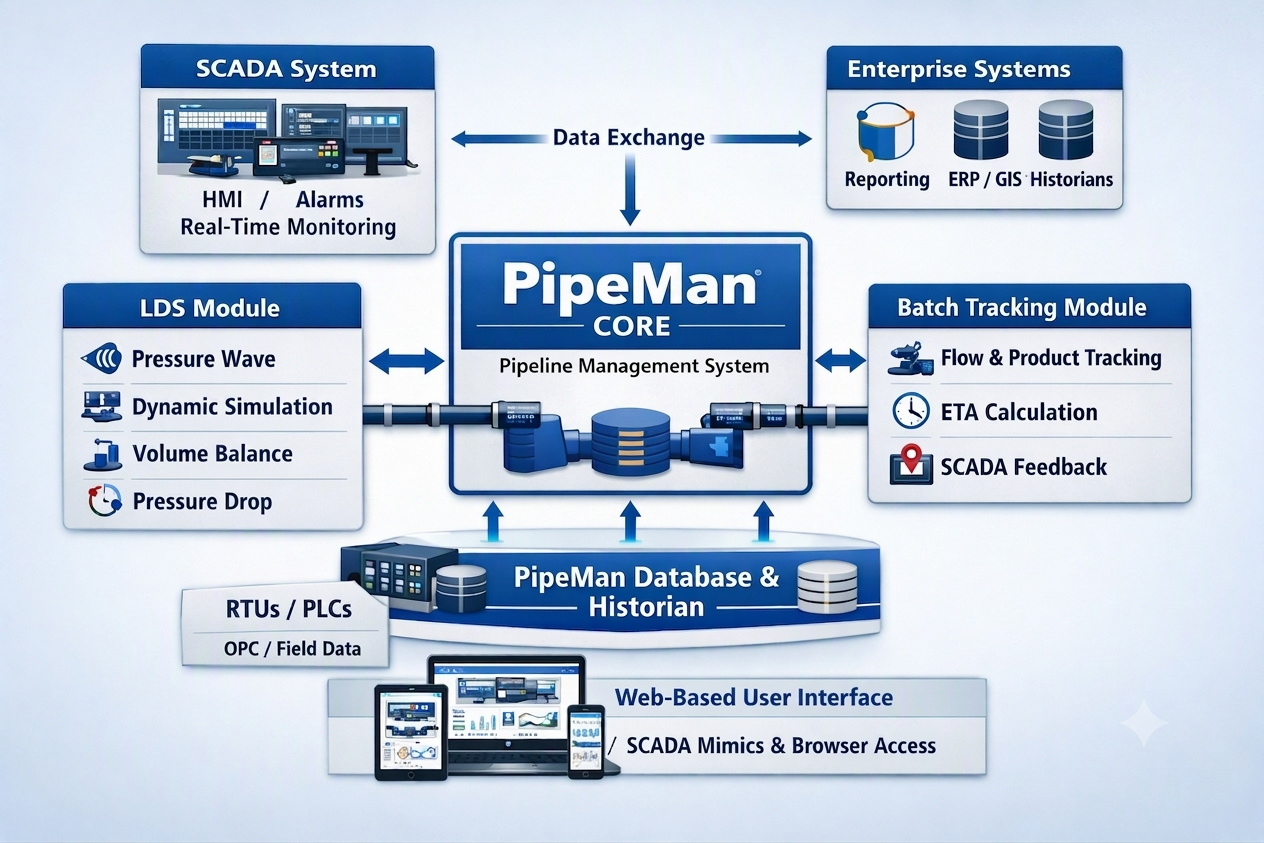
Results, critical alarms, and calculated data feed directly back into SCADA mimics, allowing operators to work within their primary interface without needing context switches
Core Modules & Features
1. Leak Detection & Location (PipeDec)
PipeMan’s PipeDec module applies tailored calculation strategies based on whether the pipeline carries gas or liquid. Results are evaluated by an intelligent Method Arbiter, which computes statistical leak probability and pinpoints exact geographical/GPS coordinates on embedded interactive maps.
A. Gas Pipelines LDS Methods
Due to the high compressibility and distinct dynamic behavior of gases, PipeMan utilizes two primary methods for gas networks:
- Pressure Wave Method (PWM): Detects transient negative pressure waves generated by the sudden onset of a leak. Offers rapid response, high sensitivity, and precise leak positioning along the gas line.
- Volume Balance Method (VBM): Processes inventory balance across pipeline sections by accounting for total gas inlets and outlets (compensated for pressure and temperature changes) to detect long-term or steady imbalance.
B. Liquid Pipelines LDS Methods
For liquid transportation, PipeMan utilizes a broader suite of hydraulic models:
- Pressure Wave Method (PWM)
- Dynamic Simulation Method (DSM): Transient-compensated real-time hydraulic modeling.
- Model-Compensated Volume Balance
- Pressure Drop Method (PDM): Static/shut-in leak monitoring via temperature-corrected pressure decay gradients.
2. Batch & Pig Tracking (PipeTrack)
- Parcel & Batch Tracking (Liquids): Tracks multiple product batches simultaneously across complex pipeline topologies using live flow rates and scheduled transaction tables. Provides operators with real-time Estimated Time of Arrival (ETA) at stations and terminals.
- Interface Handling: Detects product boundaries based on density and colorimeter inputs, calculates interface volumes, and automates cut-off actions.
- Scraper / Pig Tracking (Gas & Liquids): Computes real-time pig/scraper positions along both gas and liquid lines, incorporates custom pig slide factors, updates positions automatically via pig signallers, and alerts operators prior to receiver chamber arrival.
3. Custody Transfer Module (CTM)
Extends the platform to manage multi-product scheduling, pumping history, gas flow metering, and commercial ticketing. CTM provides tailored web-based views for dispatchers, operators, accountants, and management.
- Automated meter ticket and batch protocol generation.
- Flow computer, mass, and volume calculations compensated to standard pressure and temperature conditions.
- Direct integration with enterprise ERP and logistics systems.
4. Data Analytics, Historian & Reporting
- PipeMan Historian: A robust logging engine that collects field telemetry into a centralized database with built-in store-and-forward mechanisms to ensure zero data loss during network outages.
- Advanced Reporting: Standard & custom printable reports (PDF, Excel, Word, CSV).
- Content Management System (CMS): A web portal for monitoring network health, tracking pumping/compressor KPIs, evaluating uptime, and reviewing historical trends without needing direct SCADA access.
5. Training & Pipeline Simulation
- Offline Training Simulator: Mirrors the live SCADA/PipeMan interface to train operators on normal gas/liquid operations and emergency scenarios (e.g., compressor/pump trips, sudden valve closures, or leaks).
- Hydraulic Simulator: Allows engineers to construct real-time or accelerated dynamic models of complex liquid or gas networks to validate configurations during Factory Acceptance Testing (FAT).